

- Home
-

MBT Bolt Screw Rebar Coupler: Fast and Reliable Mechanical Splicing Technology
Views: 0 Author: Site Editor Publish Time: 2026-09-17 Origin: Site


Executing high-strength in-situ rebar splices in congested spaces is a massive headache for site engineers. You often hit scenarios where bar rotation, threading, or lap splicing is physically impossible. We frequently deal with fixed starter bars that are damaged, misaligned, or buried in tight formwork where standard threading machinery simply cannot fit. Forcing conventional splicing methods into these restricted zones compromises structural integrity and causes severe project bottlenecks.
Project delays, specialized labor requirements, and structural non-compliance pile up fast when you rely on traditional bar-end preparation. Lap splicing in heavily reinforced zones blocks concrete consolidation, leading to honeycombing. Threaded mechanical splices demand precision end-preparation and the ability to rotate the bar. The MBT bolt screw coupler provides a verifiable, tension-based mechanical splicing solution that bypasses bar-end preparation entirely. It shifts the focus from labor-intensive site prep to standardized, tool-driven installation, ensuring immediate load transfer and strict code compliance without altering the existing reinforcement.
Key Takeaways
Preparation-Free Splicing: MBT bolt screw couplers eliminate the need for threading, swaging, or welding the rebar ends, relying instead on lockshear bolt technology for immediate load transfer.
Application Specificity: Ideal for structural retrofits, extension of existing starter bars, and highly congested rebar cages where the fixed bar is already in place and bar rotation is restricted.
Environmental Adaptability: Availability of specialized variants, such as the epoxy coated bolt rebar coupler and weldable bolt screw rebar coupler, allows for integration into corrosive environments and structural steel transitions.
Verifiable Installation: Quality control is simplified through visual inspection of sheared bolt heads, removing subjective installation errors associated with manual torquing or lap tying.
The Mechanics of the MBT Bolt Screw Coupler
Maintaining continuous load paths without reducing the cross-sectional area of the reinforcement bar is a fundamental requirement in structural engineering. Any reduction in the bar diameter, like cutting a thread too deep, creates a weak point that will fail under tension. Mechanical splicing must bridge two independent bars and transfer massive static and dynamic loads across the joint. The system has to do this while dealing with the natural deformations and rough rib patterns of standard reinforcement steel.
Lockshear Bolt Technology and Clamping Force
This system relies on heavy-duty lockshear bolts and a thick-walled steel sleeve. The coupler body features internal serrations designed to grip the ribs of the reinforcement bar. You drive the bolts inward using a pneumatic or electric impact wrench. They embed directly into the surface of the rebar. This action generates a massive clamping force, physically pushing the bar against the internal serrations on the opposite side of the coupler body.
The bolts are manufactured with a specific shear plane engineered into the head. Once the optimal clamping torque is reached, the head of the bolt physically snaps off. This mechanism guarantees a direct transition of forces. Tension and compression loads travel from the rebar, through the embedded bolt points, and into the steel wall of the coupler body. Because the bolts bite into the steel and the serrations interlock with the bar deformations, the splice achieves full capacity. The connection stays rigid under cyclic loading, making it highly effective for seismic applications where dynamic load reversal is a primary design consideration.
Component
Mechanical Function
Load Transfer Role
Lockshear Bolts
Embeds into the rebar surface at a specific torque.
Transfers shear forces from the bar into the coupler sleeve.
Internal Serrations
Interlocks with the natural deformations of the rebar.
Prevents bar slip under heavy tensile loading.
Coupler Sleeve
Contains the expansive forces generated by the bolts.
Acts as the primary bridge for tension and compression loads.
Center Stop
Provides a physical barrier inside the sleeve.
Ensures equal embedment depth for both incoming bars.
Eliminating Bar End Preparation
Bypassing threading and swaging equipment on-site gives contractors a massive operational advantage. Traditional mechanical splices require the bar ends to be cut perfectly square, peeled, and threaded using heavy machinery. This demands a dedicated fabrication area, skilled operators, and continuous quality control to check thread tolerances. When you deal with fixed starter bars extending from an existing concrete pour, bringing a threading machine to the bar is usually impossible.
Removing the need for end preparation drastically accelerates project timelines. When unexpected splice requirements pop up—like a design change, a damaged bar that needs extending, or a pour break adjustment—site teams can execute the connection immediately. The coupler simply slides over the rough-cut end of the rebar. You tighten the bolts, the heads shear off, and the splice is done. This immediate execution prevents concrete pour delays and keeps the critical path moving forward. You do not need to wait for off-site fabrication or specialized threading crews to arrive.
Core Evaluation Criteria for Mechanical Splicing
Selecting the correct mechanical splice requires a hard look at structural performance, site logistics, and economic impact. Engineers and contractors must align the physical capabilities of the coupler with the specific demands of the structural node. You cannot just pick a coupler based on a catalog; you have to evaluate how it performs in the mud, inside tight formwork, and under actual site conditions.
Tensile Strength and Code Compliance
Structural codes dictate strict performance metrics for mechanical splices. Standards like ACI 318, Eurocode 2, and BS 8110 require splices to perform reliably under extreme stress. A primary metric is the ability of the splice to exceed the specified yield strength of the reinforcement bar. In many jurisdictions, a mechanical splice must develop at least 125% to 150% of the bar specified yield strength. Under ACI guidelines, achieving the specified tensile strength of the bar classifies it as a Type 2 splice, which is mandatory for high-seismic zones.
This over-strength requirement ensures that if a structural overload happens, the reinforcement bar will yield and elongate before the mechanical splice fails. The lockshear mechanism meets these criteria by creating a mechanical interlock that does not rely on the friction of concrete or the integrity of a cut thread. Independent laboratory testing and regional certification are mandatory. You must verify that the specific coupler model meets the exact grade and diameter requirements of your project before installation begins.
Installation Speed vs. Unit Cost
Evaluating the economics of mechanical splicing requires looking beyond the initial purchase price. The unit material cost of a bolted coupler is generally higher than a standard threaded coupler or the raw steel required for a lap splice. However, the true metric is the installed cost. A realistic cost-benefit analysis must account for the labor hours saved by eliminating bar preparation.
The break-even point for contractors heavily favors bolted systems in low-volume, high-complexity scenarios. If a site requires ten splices on fixed starter bars inside a deep excavation, the cost of mobilizing threading equipment, setting up a power supply, and maneuvering the machinery into the trench far exceeds the premium paid for the bolted couplers. You also eliminate the need for cutting fluids and the scrap waste generated by trimming bars to fit threading machines. Contractors must calculate the labor rate, equipment rental, and potential delay costs to accurately assess the financial viability of the system.
Space Constraints, Concrete Cover, and In-Situ Feasibility
Congested structural nodes, like beam-to-column joints or core wall transitions, leave minimal room for reinforcement splicing. Lap splicing doubles the amount of steel in the transition zone, severely restricting the flow of aggregate during the concrete pour. This congestion often leads to voids and honeycombing, which requires expensive remedial grouting and chipping later on.
The compact profile of the bolted coupler preserves critical concrete cover. While it is larger than a threaded coupler initially due to the bolt heads, once the heads shear off, the remaining profile is relatively streamlined. This allows concrete and vibrators to pass through the cage efficiently. Site teams must also account for the minimum clearance required to operate the installation tools. Pneumatic or electric impact wrenches require lateral space to access the bolts. Engineers must detail the rebar layout to ensure sufficient gap between parallel bars, allowing the tool socket to seat fully on each bolt head during installation.
Rebar Size
Minimum Lateral Clearance Required
Recommended Impact Wrench Drive
12mm - 16mm (#4 - #5)
50mm
1/2 inch drive
20mm - 25mm (#6 - #8)
75mm
3/4 inch drive
32mm - 40mm (#10 - #11)
100mm
1 inch drive
MBT Coupler Variants and Application Scenarios
Construction environments vary wildly, demanding specialized solutions for different structural interfaces and exposure conditions. Manufacturers have developed specific variants of the bolted coupler to address these unique engineering challenges on site.
Transitioning Systems: MBT Parallel Thread Rebar Coupler
Hybrid scenarios frequently occur where prefabricated rebar cages must connect to existing in-situ reinforcement. The MBT parallel thread rebar coupler bridges this gap perfectly. One end of the coupler features a standard parallel thread, while the other utilizes the bolted lockshear mechanism.
During prefabrication, the threaded end is spun onto the prepared bars of the new cage in the controlled environment of the steel yard. When the crane lowers the cage into the excavation, the bolted end simply slides over the existing, unprepared starter bars. This hybrid approach provides structural continuity between threaded and non-threaded load paths. It eliminates the need to rotate the heavy prefabricated cage to engage the threads, solving a major logistical headache for crane operators and steel fixers working in tight shafts.
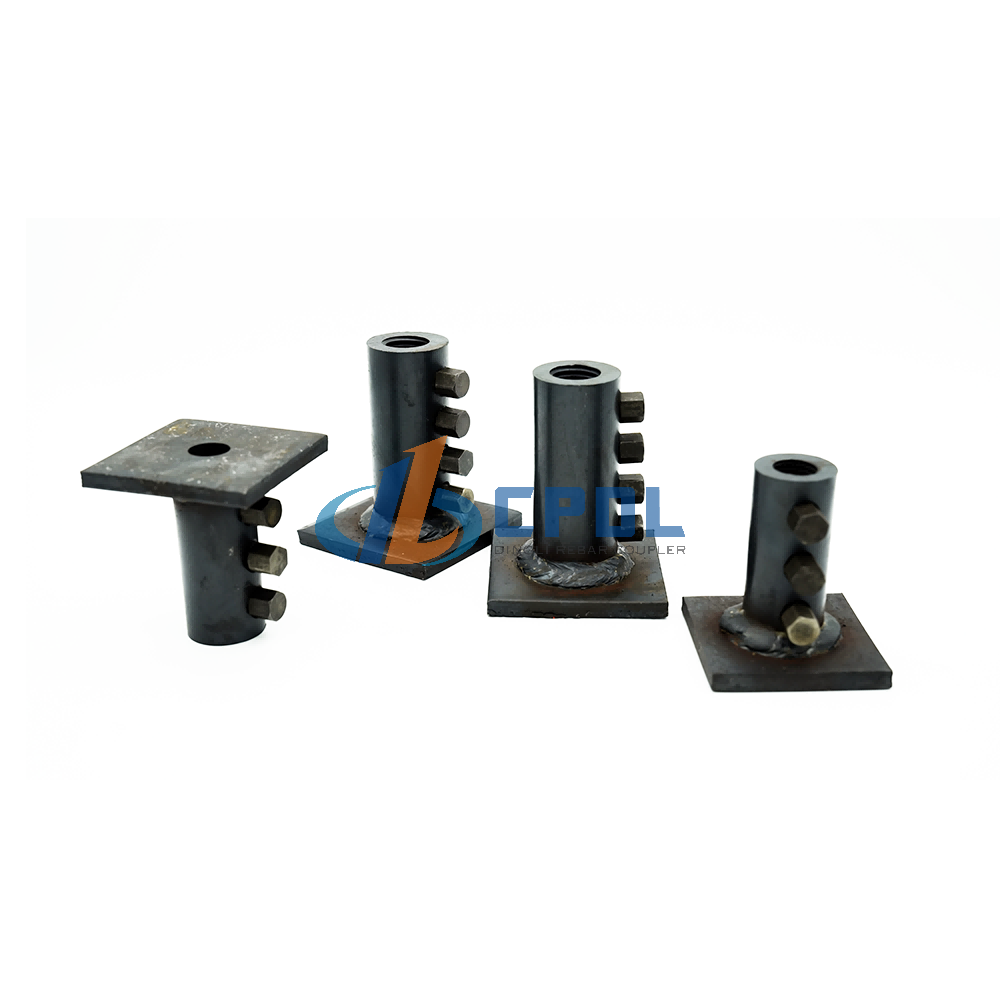
Structural Steel Integration: Weldable Bolt Screw Rebar Coupler
Connecting concrete reinforcement directly to structural steel members, steel piles, or liner plates requires a specialized interface. The weldable bolt screw rebar coupler is manufactured from specific low-carbon steel grades designed to accommodate structural welding without compromising the integrity of the coupler body.
Standard high-carbon coupler steel becomes brittle if welded directly, leading to cracking under load. The weldable variant accepts standard welding procedures. Site engineers must enforce strict metallurgical protocols, including specific pre-heating requirements and the use of low-hydrogen electrodes (like E7018), to prevent heat-affected zone cracking. Once the coupler is securely welded to the steel plate or beam, the rebar is inserted into the open end, and the lockshear bolts are tightened. This creates a robust composite connection that transfers loads directly from the concrete reinforcement into the structural steel frame.
Corrosive Environments: Epoxy Coated Bolt Rebar Coupler
Marine structures, bridge decks, and chemical processing plants expose reinforcement to aggressive chloride attack. In these environments, standard bare steel couplers will corrode, expand, and spall the surrounding concrete. The epoxy coated bolt rebar coupler provides the necessary defense against chemical degradation.
The coupler body undergoes a fusion-bonded epoxy coating process, creating a durable, impermeable barrier. A main engineering challenge is ensuring the coating does not interfere with the mechanical grip. Manufacturers design the internal serrations and the hardened bolt points to pierce through the epoxy layer on the rebar during installation. This ensures direct steel-to-steel contact for load transfer. After installation, the sheared bolt heads and any exposed threads must be touched up with a compatible field-applied epoxy mastic. This final step seals the connection completely against moisture ingress and maintains the anti-corrosion envelope.
Trade-Offs: MBT Bolt Screw Couplers vs. Traditional Splicing
Selecting a splicing method requires weighing the structural benefits against the logistical and material costs. A direct comparison highlights where bolted mechanical splices offer the most value on a job site.
MBT vs. Lap Splicing
Lap splicing relies entirely on the bond strength between the steel and the surrounding concrete to transfer loads. It requires long lengths of overlapping rebar, which consumes significant material and space inside the formwork.
Evaluation Metric
Lap Splicing
MBT Bolt Screw Coupler
Load Path
Indirect; relies on concrete bond and confinement.
Direct mechanical steel-to-steel transfer.
Cage Congestion
High; doubles the steel ratio in the splice zone.
Low; single bar profile maintained.
Material Waste
High; requires 40 to 60 bar diameters of overlap.
Zero overlap required.
Large Diameter Bars
Often prohibited by code for bars >36mm (#11).
Fully compliant for all large diameters.
The material waste associated with lap lengths becomes financially prohibitive when dealing with large-diameter bars. Many structural codes prohibit lap splicing for bars exceeding 36mm (#11) due to the massive development lengths required and the unreliability of the concrete bond at that scale. The bolted coupler provides a direct load path independent of the concrete, resolving both congestion and code compliance issues immediately.
MBT vs. Traditional Threaded Couplers
Traditional threaded systems are the industry standard for new construction, but they carry hidden logistical costs. The upfront material cost of a bolted coupler is generally higher than a standard threaded sleeve. However, threaded systems demand threading machinery, cutting fluids, skilled operators, and routine calibration of the threading dies.
Threaded systems also require the bar to be cut perfectly square. In many cases, the bar ends must be upset (enlarged) before threading to maintain the cross-sectional area. The ideal use case for threaded couplers is high-volume, pre-planned prefabrication where economies of scale apply. Bolted couplers dominate in remedial works, retrofits, and restricted sites where bars are already fixed in place, and bringing heavy machinery to the joint is unfeasible. If you cannot spin the bar, and you cannot fit a threading machine over the end, the bolted coupler is your only viable mechanical option.
Implementation Risks and Mitigation Strategies
While the installation process is straightforward, mechanical splicing carries inherent risks if site teams deviate from manufacturer specifications. Strict adherence to installation protocols is required to guarantee structural performance.
Torque Verification and Shear-Off Failures
The integrity of the splice depends entirely on the bolts reaching the correct clamping force before shearing. A significant risk is premature bolt shearing. This happens if the impact wrench is improperly calibrated, if the tool is applied at an angle, or if debris clogs the bolt threads. If a bolt shears before embedding fully into the rebar, the clamping force is compromised, leading to potential slip under tension.
Mitigation protocols must be strictly enforced on site. Site teams must use the specific pneumatic or electric impact wrenches specified by the manufacturer, ensuring they deliver the required torque output. Do not use standard battery-powered drills. Tightening must follow a sequential pattern. Operators must start with the bolts in the center of the coupler and work outward toward the ends. This sequence ensures the bar is seated evenly against the internal serrations and prevents the bar from being pushed out of alignment during tightening.
Alignment Issues in Congested Rebar Cages
Inserting heavy, large-diameter bolted couplers into misaligned starter bars presents a physical challenge. Starter bars often suffer from "dog-legging" or bending due to site traffic, heavy machinery bumps, or formwork movement. Forcing a rigid steel sleeve over severely bent bars can induce massive initial stresses into the connection before any structural load is applied.
Engineering tolerances for bar misalignment must be established prior to installation. Most manufacturers specify a maximum allowable slope for the incoming bars. If a bar exceeds this tolerance, it must be cold-bent back into alignment using approved tools. Never heat the rebar with a torch to bend it, as this destroys the metallurgical properties of the steel. The coupler must slide over the bars without requiring excessive force. If the bar binds against the internal serrations before reaching the center stop, the splice will not achieve full embedment.
Quality Control and Inspection Protocols
The primary advantage of the lockshear system is the simplicity of visual inspection. However, site engineers must still execute a formal quality control checklist to sign off on the structural node before allowing the concrete pour to proceed.
Verify Bar Penetration: Ensure the rebar has been inserted past all required bolt locations and meets the center stop of the coupler. Mark the bar with chalk prior to insertion to visually confirm the embedment depth.
Confirm Bolt Shear: Visually inspect every bolt on the coupler. Every single bolt head must be physically sheared off. A partially sheared or intact bolt indicates an incomplete installation.
Check Alignment: Ensure the spliced bars maintain a straight load path and that no severe gaps exist between the bar and the open ends of the coupler body.
Document Installation: Record the location, bar diameter, and coupler batch number in the site inspection log for traceability and final handover documentation.
Verify Tool Calibration: Ensure the impact wrenches used on site are rated for the correct torque and have sufficient air pressure if using pneumatic systems.
Conclusion
The MBT bolt screw coupler stands as a highly reliable solution for complex, in-situ splicing where traditional methods fail structurally or logistically. By eliminating the need for bar-end preparation, threading, and bar rotation, this technology accelerates project timelines and resolves severe cage congestion issues. The reliance on verifiable lockshear technology ensures that every connection meets stringent structural codes for both tension and compression, providing peace of mind in critical load-bearing applications.
Specifying these systems should be based on a clear logistical evaluation. Engineers should shortlist bolted couplers when faced with the impossibility of bar rotation, the absence of on-site threading capabilities, and the need for immediate, verifiable load transfer. While the unit material cost is higher than traditional methods, the massive reduction in labor, equipment mobilization, and project delays frequently results in a lower total installed cost.
To implement this technology effectively, take the following steps:
Request comprehensive technical data sheets and independent laboratory test reports from the manufacturer to verify compliance with your specific regional structural codes.
Conduct a site-specific cost-to-labor analysis, comparing the mobilization of threading equipment against the rapid installation of bolted couplers for your specific splice volume.
Integrate the manufacturer sequential tightening protocols and visual inspection checklists directly into your site quality assurance documentation.
Specify the correct variant—whether standard, weldable, or epoxy-coated—based on the specific environmental exposure and structural interface of the node.
FAQ
Q: What does MBT stand for in rebar splicing?
A: MBT stands for "Mechanical By-Tension." It refers to a method of joining reinforcement bars using mechanical clamping force rather than threading, swaging, or lap tying. The system relies on heavy-duty bolts that embed into the rebar, transferring tension and compression loads directly through the steel coupler body.
Q: What is the primary advantage of an MBT bolt screw coupler over a threaded coupler?
A: The primary advantage is the complete elimination of bar-end threading, swaging, or rotation. This allows site teams to install the coupler immediately on existing, fixed, or damaged rebar using only an impact wrench, saving significant time and removing the need for heavy threading machinery on site.
Q: Can a weldable bolt screw rebar coupler be used for load-bearing structural steel connections?
A: Yes. Weldable variants are specifically manufactured from compatible low-carbon steel grades. This allows for structural welding to steel plates, piles, or beams using standard procedures while maintaining the mechanical splice integrity on the rebar end. Proper pre-heating and welding protocols must be followed.
Q: How do you verify that an MBT coupler is installed correctly?
A: Verification is primarily visual. The installation is complete and structurally verified only when all the lockshear bolt heads have physically sheared off. This shearing occurs precisely at the manufacturer specified torque, ensuring the correct clamping force has been applied to the rebar.
Q: Are epoxy coated bolt rebar couplers suitable for marine construction?
A: Yes, they are highly suitable. The fusion-bonded epoxy coating protects the exterior of the coupler against chloride-induced corrosion common in marine environments. During installation, the hardened bolts pierce the epoxy on the rebar, ensuring the internal mechanics still provide full steel-to-steel mechanical grip.
Q: Does the MBT parallel thread rebar coupler require rotation of the fixed bar?
A: No. The parallel thread side is pre-installed onto a rotating bar during cage prefabrication. Once the cage is lowered into position, the MBT bolted side simply slips over the fixed, non-rotating in-situ starter bar. This hybrid design completely solves bar rotation constraints on site.
Q: What happens if the rebar ends are not cut perfectly square before using an MBT coupler?
A: While a square cut is optimal for seating against the center stop, MBT couplers have a much higher tolerance for rough or angled cuts compared to threaded systems. As long as the bar is inserted far enough to fully engage all the required lockshear bolts, the splice will achieve its full structural capacity.
SUBSCRIBE TO OUR NEWSLETTERProfessional manufacturer of high-quality rebar couplers in China. We provide reliable, durableand cost-effective rebar connecting solutions for construction projects worldwide.- CUSTOM GOODS
- ABOUT CPDL
- GET IN TOUCH +86-13371462215 Xinfa Ind, Area, Chiping, LiaochengCity , Shandong Province, China
- SOCIAL FOLLOW
 English


