

- Home

Rebar Coupler: Functions and Core Purposes in Reinforced Concrete
Views: 0 Author: Site Editor Publish Time: 2026-06-29 Origin: Site


In modern reinforced concrete construction, the continuity of steel reinforcement determines the overall structural safety, ductility, and load-bearing capacity of buildings, bridges, tunnels and precast components. Rebar couplers—also named mechanical splices or rebar connectors—have replaced conventional lap splicing and field welding as the mainstream rebar joint solution for large-scale, high-performance engineering projects worldwide.
Traditional connection methods carry obvious inherent defects: lap splices require lengthy overlapping steel segments that trigger steel waste and dense reinforcement congestion at beam-column joints, while welding relies on skilled labor, generates fire hazards, and creates heat-affected zones that degrade steel mechanical performance. As global construction shifts toward industrialization, seismic resilience and sustainable cost control, engineered rebar couplers deliver a standardized, reliable mechanical joint that transfers tension and compression loads directly between two rebars end-to-end without relying on concrete bonding or thermal processing. This blog elaborates on the core functions, working mechanisms, practical purposes, classification, industrial advantages and application scenarios of rebar couplers, providing clear reference for engineers, contractors and construction managers.
1. Core Definition & Fundamental Working Principle of Rebar Couplers
A rebar coupler is a precision-manufactured metal sleeve designed to butt-connect two reinforcing bars, forming a monolithic mechanical splice that realizes full force transmission along the reinforcement axis. Its core logic lies in direct mechanical interlocking instead of indirect load transfer via concrete adhesion. The general installation workflow shared by most threaded couplers follows five standardized steps:
Rebar end preparation: Cut rebar ends flat and clean surface rust or burrs to guarantee matching contact;
Thread forming: Roll or machine uniform external threads on bar ends with dedicated rolling equipment;
Coupler positioning: Screw the inner-threaded sleeve onto the processed rebar ends;
Torque locking: Tighten the joint with a torque wrench to reach specified pre-tightening force and full thread engagement;
Load transmission: The rigid sleeve bears tensile, compressive and cyclic loads and evenly distributes stress between two rebars without displacement or slip.
For non-threaded couplers including MBT bolted couplers and cold-extrusion couplers, the force transfer relies on bolt clamping or radial plastic deformation of sleeves to bite into rebar transverse ribs, eliminating the threading process while maintaining equal-strength connection performance. Regardless of structural type, all qualified couplers comply with international standards ISO 15835, ACI 318, BS 8597 and local national codes, passing tensile, slip, fatigue and cyclic seismic loading tests before factory delivery.
2. Primary Functional Roles of Rebar Couplers in Reinforced Concrete
2.1 Realize Continuous Tension and Compression Load Transfer
The most essential function of rebar couplers is maintaining reinforcement continuity under all load conditions. Lap splices transmit pulling force through friction between overlapping steel and surrounding concrete, which loses efficiency under high tension or seismic reciprocating loads. Mechanical couplers create a rigid metal connection that develops 100% or even over 110% of the parent rebar’s nominal strength, ensuring fractures occur on the steel bar body rather than the joint under ultimate load. Under compressive loads such as vertical column bearing pressure, couplers avoid the instability risk of loose lap overlaps, securing consistent axial load transmission for vertical structural members.
2.2 Eliminate Reinforcement Congestion and Improve Concrete Compaction
In critical stress zones like beam-column joints, shear wall connections and bridge piers, overlapping lap rebars stack densely, forming steel cages that block concrete flow and trigger honeycombing, voids and incomplete vibration compaction. Couplers adopt compact end-to-end butt joints with no extra overlapping steel, greatly opening internal space for concrete pouring. This function directly elevates concrete construction quality, reduces hidden structural defects and extends the long-term durability of reinforced concrete components.
2.3 Resist Cyclic Fatigue and Seismic Reciprocating Loads
Structures such as highway bridges, subway tunnels and high-rise seismic buildings endure millions of repeated dynamic loads and earthquake reciprocating tension-compression cycles. Welded joints contain internal microcracks and uneven metallurgical structures prone to fatigue fracture; lap splices experience repeated bond slip under cyclic loads. Certified seismic-grade couplers pass strict cyclic loading tests, featuring anti-loosening self-locking structures (one-touch couplers with built-in elastic lock rings) that prevent joint loosening under vibration, retaining stable ductility and energy dissipation capacity during seismic events to meet the “damage without collapse” design standard.
2.4 Solve Construction Limitations of Fixed-Length Rebars
Factory-produced rebars are limited to standard lengths of 9m or 12m, while super-high columns, long bridge girders and tunnel linings require continuous reinforcement spanning dozens of meters. Couplers enable segmented assembly of short rebars into integral long reinforcement systems, breaking the length restriction of raw steel products and simplifying transportation, hoisting and on-site reinforcement cage assembly. Special position couplers further adapt to confined construction spaces where rebars cannot be rotated during installation.
3. Four Core Purposes for Adopting Rebar Couplers Over Traditional Joints
3.1 Cut Construction Material Costs and Reduce Steel Wastage
Lap splicing requires overlapping lengths equivalent to 40–60 times the rebar diameter, consuming massive extra steel and raising material expenditure. Rebar couplers eliminate overlapping segments entirely, cutting reinforcement consumption by 20% to 50% based on bar diameter and structural layout. Though coupler sleeves carry individual procurement costs, the total project cost drops significantly when calculating saved steel tonnage, reduced concrete volume and fewer post-repair costs for poor compaction defects. This economic benefit makes couplers a cost-effective choice for large infrastructure and super high-rise projects.
3.2 Accelerate Site Construction Progress and Lower Labor Dependence
Welding demands certified welders, long operation time and power supply, while binding lap splices involves repetitive manual tying work. Coupler installation only requires torque wrenches or hydraulic extrusion equipment with simple worker training; threaded coupler tightening takes minutes per joint, far faster than welding and lapping. Prefabricated thread processing can be completed in factories, shifting complex machining off-site and shortening on-site construction cycles, which is especially valuable for tight-schedule commercial and precast projects. Meanwhile, coupler construction eliminates open-flame welding, lowering fire risks and improving overall site safety.
3.3 Standardize Quality Control and Stabilize Joint Performance
Welding quality fluctuates drastically with welder skill, wind, temperature and power conditions, easily forming cold joints, pores and slag inclusions. Lap splice performance relies on concrete pouring quality and lap length compliance, bringing unpredictable quality deviations. Rebar couplers are factory mass-produced under CNC precision machining with unified material metallurgy standards; on-site inspection only needs torque verification to judge joint tightness, forming quantifiable, intuitive quality control procedures. Consistent joint performance reduces post-construction inspection and maintenance costs for owners.
3.4 Promote Green, Industrialized and Prefabricated Construction
As the global construction industry advances toward industrialization, dry assembly of precast components becomes mainstream. Grout couplers are the core connection component for precast columns, wall panels and beams, realizing reliable “dry joint” assembly without cast-in-place lap steel. Coupler technology minimizes steel waste, cuts welding energy consumption and toxic flue emissions, aligning with sustainable construction and carbon reduction targets. Epoxy-coated anti-corrosion couplers further expand application to coastal, chemical corrosion environments, extending structural service life and reducing long-term carbon emissions from renovation works.
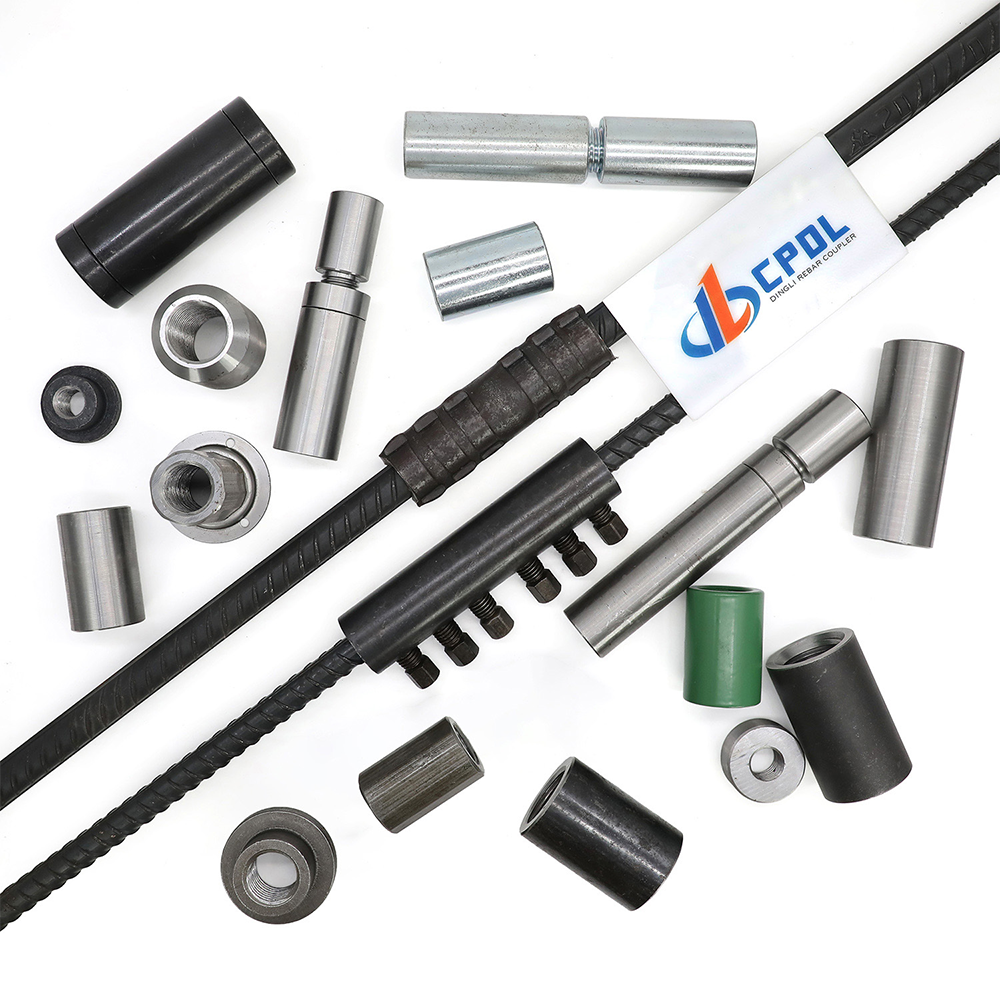
4. Main Coupler Types Matching Different Functional Purposes
Different project conditions and functional demands correspond to specialized coupler designs, each with targeted core applications:
Parallel Thread Couplers: The most widely used universal type, delivering joint strength exceeding parent rebar, suitable for general high-rise buildings and bridge main reinforcement;
Taper Thread Couplers: Fast assembly without precise torque calibration, ideal for heavy-load industrial structures with rapid construction requirements;
MBT Bolted Couplers: No threading needed on rebar ends, perfect for later-stage structural repair, retrofitting and renovation projects;
Grout-Filled Couplers: Pre-embedded in precast components, connected via high-strength grout pouring, the standard solution for all prefabricated concrete construction;
Position / Left-Right Thread Couplers: Adapt to confined spaces where rebars cannot rotate, commonly used in tunnel lining and dense reinforcement cages;
Cold Extrusion & One-Touch Self-Locking Couplers: Excellent anti-fatigue performance, prioritized for seismic zones, long-span bridges and dynamic load structures.
5. Typical Engineering Application Scenarios Driven by Coupler Functional Demands
The multiple core functions of rebar couplers determine their wide coverage across all high-standard construction sectors:
Super High-Rise Buildings: Vertical column and shear wall main reinforcement connections relieve joint congestion, guarantee seismic continuity and save steel materials;
Bridges & Viaducts: Pier, girder and deck joints resist long-term vehicle fatigue loads, improving structural durability;
Tunnels & Metro Segments: Position and MBT couplers fit narrow lining construction spaces, ensuring waterproof reinforcement continuity;
Precast Modular Construction: Grout couplers realize fast assembly of precast wall, beam and column components;
Critical Infrastructure (Nuclear Plants, Dams, Airports): Strict quality and safety standards mandate mechanical couplers over unreliable lap or welded joints;
Coastal & Corrosive Environment Projects: Epoxy-coated anti-corrosion couplers prevent steel joint rusting and structural degradation.
6. Rebar Coupler vs Lap Splice: A Comparative Review of Functional Advantages
To intuitively reflect the core value of couplers, the comparison table below contrasts key performance indicators with traditional lap splicing:
Evaluation Criteria
Rebar Coupler
Lap Splice
Steel Material Consumption
Low (20–50% savings)
High (long overlapping segments)
Joint Load-Bearing Strength
High (full rebar strength)
Medium (limited by concrete bond)
Reinforcement Congestion
Minimal
Severe at joints
On-Site Construction Speed
Fast, simple tightening
Slow, manual binding required
Concrete Compaction Quality
Excellent, smooth concrete flow
Prone to voids and honeycombing
Seismic & Fatigue Performance
Stable, certified for cyclic loads
Weak, easy bond slip under reciprocating loads
Overall Project Comprehensive Cost
Lower (material & labor savings)
Higher (extra steel and defect repair cost)
For all performance-critical, large-scale and seismic-resistant projects, rebar couplers outperform lap splices comprehensively in structural function, construction efficiency and economic benefit. Welding falls further behind due to slow speed, high labor cost and unstable joint quality, making couplers the optimal modern alternative.
Conclusion
Rebar couplers are far more than simple steel sleeves—they serve as indispensable structural components that guarantee reinforcement continuity, resolve construction bottlenecks of traditional joint methods, and drive the upgrading of global reinforced concrete engineering. Their core functions of full tension-compression load transfer, congestion reduction, seismic fatigue resistance and fixed-length rebar assembly address long-standing pain points in construction design and site operation, while their core purposes of cost control, schedule acceleration, standardized quality management and green industrialization fit the development trend of modern infrastructure.
For engineers and contractors, selecting matched coupler types based on structural load, construction space, precast requirements and environmental corrosion conditions can maximize structural safety, cut total project expenditure and streamline construction workflows. As coupler manufacturing technology and international testing standards continue to mature, mechanical rebar splicing will further replace outdated lap and welding joints, becoming the universal standard for reinforced concrete reinforcement connection worldwide.
SUBSCRIBE TO OUR NEWSLETTERProfessional manufacturer of high-quality rebar couplers in China. We provide reliable, durableand cost-effective rebar connecting solutions for construction projects worldwide.- CUSTOM GOODS
- ABOUT CPDL
- GET IN TOUCH +86-13371462215 Xinfa Ind, Area, Chiping, LiaochengCity , Shandong Province, China
- SOCIAL FOLLOW
 English


